Table of Contents
- How Gutters Protect Your Foundation from Water Damage
- Signs of Foundation Water Damage You Should Never Ignore
- Downspout Extension Requirements: How Far Is Far Enough?
- How to Prevent Ice Dams in Winter with Proper Gutter Care
- Gutter Pitch, Seamless Gutters, and Drainage Integration
- Seasonal Maintenance Schedule for Preventing Foundation Damage with Gutters
- Frequently Asked Questions
Last Updated: September 16, 2026
How Gutters Protect Your Foundation from Water Damage
Preventing foundation damage with gutters comes down to one job: moving roof water far enough away from the house that the soil under your foundation never gets soaked. That’s the whole ballgame. A gutter system that works keeps thousands of gallons of roof runoff from landing in a six-inch strip around your foundation. A gutter system that fails dumps all of it right there, season after season.
At Metal Rivers Gutter Company, we’ve inspected enough homes around Fort Collins to know that most foundation trouble starts above ground, not below it. The FEMA guidance on protecting homes from water damage makes the same point: roof drainage is one of the cheapest things a homeowner can control, and one of the most commonly neglected.
Water is patient. It finds the low spot, then it makes the low spot lower.
Soil Saturation, Hydrostatic Pressure, and Foundation Heave
Soil saturation is the condition where the ground around your foundation holds more water than it can drain away. When that happens, the soil swells, and the pressure it puts against your foundation walls is called hydrostatic pressure.
Different soils behave differently here. Clay-heavy ground, common along the Front Range, expands hard when wet and shrinks when it dries. That cycle pushes and pulls on foundation walls all year. Sandy soil drains faster but erodes easily, which can leave voids under a footing. Either way, the fix starts with getting roof water away from the house.
The most common mistake we see is a downspout that discharges two feet from the foundation. That’s not drainage, that’s a slow leak with extra steps. Over a few seasons it shows up as a wet crawlspace or a crack above a basement window.
Signs of Foundation Water Damage You Should Never Ignore
Foundation water damage rarely announces itself. It whispers first. Knowing the signs of foundation water damage early can save you a repair bill that runs into five figures.
Watch for these:
- Foundation cracks, especially stair-step cracks in brick or block
- Water pooling in the same spot after every storm
- Soil erosion creating a visible trench along the foundation line
- Sticking doors and windows that used to open smooth
- Foundation heave, where part of the slab or porch rises out of level
- Musty smells in a basement or crawlspace
Any one of these is worth a look.
Downspout Extension Requirements: How Far Is Far Enough?
The short answer: downspouts should discharge at least 4 to 6 feet from the foundation, and farther is better on sloped ground. That’s the general rule most builders and inspectors work from. If your yard slopes toward the house, push that water 10 feet or more.
Why Soil Type Changes the Math
Clay-heavy ground, common across the Midwest and South, expands hard when wet and shrinks when it dries. That cycle pushes and pulls on foundation walls all year. When a downspout dumps water right next to the house, the clay swells, and the pressure against your foundation can crack block or push a basement wall inward. Sandy soil drains faster but erodes easily, which can leave voids under a footing.
The Whole-System Approach: Gutters, Grading, and French Drains
The piece most homeowners overlook is integration. Gutters, downspouts, grading, and French drains are one system, not four separate projects. A French drain or a properly graded swale takes what the downspout delivers and moves it away from the house for good.
Winter Ice Hazards: Where Downspouts Fail
Come winter, a downspout that’s too short or pointed the wrong way becomes an ice machine. Come winter, a downspout that’s too short or pointed the wrong way becomes an ice machine. Here’s what happens:
- Ice dams at the foundation: Meltwater from the roof runs down the downspout and dumps right next to the house. Overnight, it freezes into a solid block of ice against your foundation wall. When it thaws, that water soaks into the soil in one concentrated spot, over and over again.
- Frozen splash blocks: A splash block that stays wet and then freezes can crack and shift, directing water back toward the foundation instead of away.
- Buried line freeze-ups: If your downspout feeds a buried line and that line isn’t sloped properly, water sits in it, freezes, and blocks the whole system. The next melt has nowhere to go but over the top of the gutter.
If you’re in clay country, consider extending downspouts into a buried line that daylights 10-15 feet from the house, or tie them into a French drain. It’s more work upfront, but it solves the problem for good.
How to Prevent Ice Dams in Winter with Proper Gutter Care
Learning how to prevent ice dams in winter starts with understanding what causes them: warm attic air melts snow on the roof, the meltwater runs down to the cold eaves, and it refreezes. That ice builds a dam. Water backs up under the shingles and into the house.
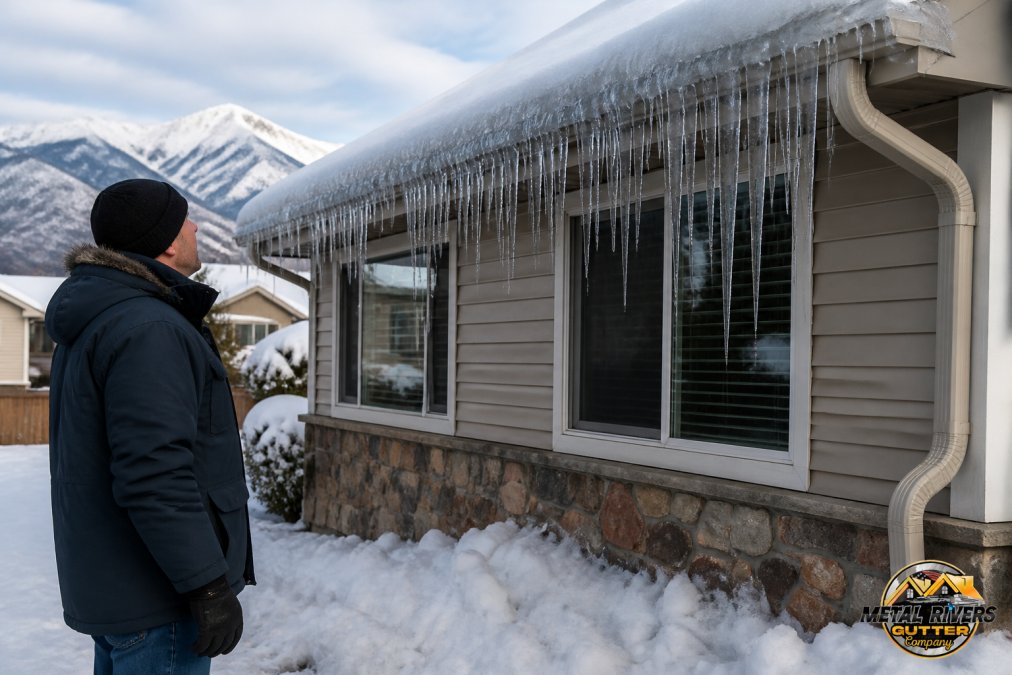
Clear your gutters before the first hard freeze, not after. Once ice sets in, you’re not cleaning gutters, you’re chipping at a glacier. A fall cleaning and a gutter guard install do more for winter foundation protection than anything you can do in January.
Gutter Pitch, Seamless Gutters, and Drainage Integration
Gutter pitch is the slight downward slope that lets water flow toward the downspouts instead of sitting in the channel. Too little pitch and water pools. Too much and it overshoots the downspout.
| Component | What It Does | What Happens If It Fails |
|---|---|---|
| Gutters | Collect roof runoff | Water sheets off eaves, erodes soil |
| Downspouts | Carry water down | Water dumps at foundation |
| Extensions | Move water 4-6+ feet away | Soil saturation at the wall |
| Grading | Directs surface water | Water pools against foundation |
| French drain | Collects subsurface water | Hydrostatic pressure builds |
Seasonal Maintenance Schedule for Preventing Foundation Damage with Gutters
A simple twice-a-year routine does more for your foundation than any single repair. Here’s the schedule we recommend to homeowners.
- Spring: Clear winter debris, check for sagging or pulled hangers, and inspect for ice damage
- Early summer: Inspect downspout extensions and splash blocks; make sure water is discharging at least 4-6 feet from the foundation
- Late summer: Check grading and look for new soil erosion; in clay soil, watch for shrinkage cracks that can channel water toward the foundation
- Fall: Full cleaning before the first freeze, the most important visit of the year
- After any major storm: Quick visual check for clogs or damage
Winter Ice Hazards: What Your Gutters Are Up Against
Come winter, your gutters face a gauntlet of ice hazards that can undo a summer of good drainage. Here’s what to watch for:
- Ice dams at the eaves: Warm attic air melts snow on the roof, and the meltwater refreezes at the cold eaves, forming a dam. Water backs up under the shingles and into the house. A clear, properly pitched gutter carries that meltwater off the roof before it can pool and refreeze.
- Frozen gutters and downspouts: If debris blocks the channel, meltwater sits, freezes, and expands. That ice can crack seams, pull hangers loose, and split downspouts. Once ice sets in, you’re not cleaning gutters, you’re chipping at a glacier.
- Ice at the foundation: When gutters overflow or downspouts dump too close, meltwater freezes in a heap against the foundation. When it thaws, it soaks the soil in one concentrated spot. Do that twenty times in a winter and you’ve got yourself a wet basement.
- Frozen splash blocks and buried lines: A splash block that stays wet and then freezes can crack and shift, directing water back toward the foundation. Buried lines that aren’t sloped properly can freeze solid, blocking the whole system.
Soil Moisture and Timing: Why Fall Matters Most
In clay soil, the fall cleaning is critical because that’s when the soil is already shrinking from summer dryness. The first heavy fall rain, or the first winter melt, can cause rapid swelling, and if your gutters are clogged, that water dumps right at the foundation. In sandy soil, erosion is the bigger risk, so fall is the time to check for voids along the foundation and add soil or mulch to regrade.
Preventing foundation damage with gutters isn’t about one big fix. It’s about keeping water moving away from the house every single season, and that’s a maintenance habit, not a one-time purchase.
Frequently Asked Questions
Do gutters really help prevent foundation damage?
Yes. Gutters and downspouts move roof water away from the foundation, which stops soil saturation and the hydrostatic pressure that leads to foundation cracks, settlement, and basement flooding. When gutters clog or downspouts dump water right at the base of the house, that water soaks into the soil and pushes against the foundation walls. Keeping gutters clean and extending downspouts at least 4 to 6 feet away is one of the simplest ways to protect your foundation.
How far should downspouts extend from the foundation?
Downspouts should carry water at least 4 to 6 feet from the foundation, and farther if your yard slopes back toward the house. Use downspout extensions, splash blocks, or buried drain lines to direct water away. If the ground already slopes toward the home, a longer extension or a French drain may be needed. The goal is to release water where it can flow away without pooling near the foundation or eroding the soil around it.
Can clogged gutters cause basement flooding?
Clogged gutters send water over the sides and straight down along the foundation. That water saturates the soil, raises moisture levels against the basement walls, and can find its way through cracks or porous concrete. In winter, the same clogs create ice dams that force meltwater under shingles and down inside walls. Regular gutter cleaning, especially after fall leaf drop, is the cheapest insurance against a wet basement.
Do gutter guards help with ice dam prevention?
Gutter guards reduce debris that causes clogs, and clear gutters drain meltwater instead of letting it refreeze at the roof edge. That helps limit ice dam formation. However, guards do not stop ice dams caused by warm attic air melting roof snow. Proper attic insulation and ventilation still matter. A quality guard like a 540 micron system keeps pine needles and leaves out, so water can flow to the downspouts even during a Northern Colorado freeze-thaw cycle.