Last Updated: November 4, 2026
Quick Summary
Custom gutter cutting on site means the gutter is roll-formed from a flat coil of metal and cut to the exact length of your roofline right in your driveway. This removes seams every ten feet and eliminates the gaps where water finds a way in. A gutter machine bends the flat metal through rollers into your chosen profile, then the run is measured and cut to fit.
- On-site fabrication removes seams that off-site fabrication forces because shops can only haul sections so long.
- Measure each straight run along the fascia board, not the shingles, which can throw your number off by an inch or more.
- Set hidden hangers every 24 inches on center and within 12 inches of every seam, outlet, and end cap.
- A common target is 1/16 inch of fall per foot of run toward the downspouts.
- A seamless run with proper slope moves meltwater off before it refreezes into ice dams and icicles.
Table of Contents
- Why Custom Gutter Cutting on Site Beats Off-Site Fabrication
- How Gutters Are Made on Site: From Coil to Finished Run
- Custom Gutter Cutting on Site Aluminum and Other Materials
- How to Order Custom Length Gutters: Measuring Your Roofline
- Cut and Drop Gutters Near Me: When a Kit Makes Sense
- Step-by-Step: On-Site Cutting, Fitting, and Hanging
- Winter Ice Hazards Your New Gutters Help Eliminate
- Get a Free Inspection and Quote from Metal Rivers
- Frequently Asked Questions
Why Custom Gutter Cutting on Site Beats Off-Site Fabrication
Custom gutter cutting on site means the gutter is roll-formed from a flat coil of metal and cut to the exact length of your roofline right in your driveway. No seams every ten feet. No truckload of pre-cut sections that almost fit.
Here is the plain truth about why it matters.
A gutter’s worst enemy is a seam. Every joint is a spot where water can find a gap, and in a place like Fort Collins, that gap turns into a drip, then a stain on the soffit, then a washout by the foundation. Off-site fabrication forces seams because a shop can only haul sections so long. On-site fabrication removes the problem entirely. For a closer look at why that matters, read our article on the benefits of seamless gutter systems.
The trade-off is real, though. On-site work takes a bigger setup, and a crew that does not know what it is doing can mangle a coil fast. If you want that precision brought to your home, see our custom seamless gutter installation in Fort Collins. That is why you want people who do this every day.
How Gutters Are Made on Site: From Coil to Finished Run
A gutter machine is the heart of the whole job. It takes a flat strip of metal and bends it through a series of rollers into the shape you picked, all in one continuous pass.
Here is the flow, start to finish:
- Load the coil. A fresh roll of aluminum, steel, or copper goes onto the machine’s spindle.
- Set the profile. The rollers are dialed to your chosen shape, K-style or half-round.
- Roll forming. The flat metal feeds through and comes out shaped, like dough through a pasta roller.
- Measure and cut. The run is measured against your roofline and cut to length.
- Finish the ends. End caps, miters, and outlets get sealed and fitted.
Custom Gutter Cutting on Site Aluminum and Other Materials
Aluminum is the workhorse for most homes. It is light, it will not rust, and it takes paint well, which is why so many homeowners pick it. Custom gutter cutting on site aluminum runs are the most common job we do.
But aluminum is not the only game in town.
- Copper costs more up front, but it ages into a rich patina and can outlast the roof. If you want the look, our custom copper gutters are fabricated right at your house.
- Galvanized steel is the tough option. It handles heavy snow load and debris better than aluminum, and it holds paint well. Take a look at our galvanized steel gutter installation if strength is your priority.
A common mistake is picking a material on price alone. Think about your trees, your roof pitch, and how long you plan to stay. That answer usually points to one clear winner.
How to Order Custom Length Gutters: Measuring Your Roofline
Ordering custom length gutters starts with one rule: measure twice, cut once. A run that is even a little short leaves a gap, and a run that is long will not seat against the corner. But the real skill is in the calculations behind the tape, and that is where most fit errors start. Accurate measurements also help determine where runoff will land, so plan how to extend downspouts away from the foundation as you lay out each gutter run.
Here is how the measurement actually works:
- Measure each straight run along the fascia, from corner to corner. Hold the tape tight against the fascia board, not the shingles, because the shingle edge can sit out past the wood and throw your number off by an inch or more.
- Note every corner and angle. Inside and outside corners each need a miter, and the angle is rarely a perfect 90 degrees on an older house. Measure the angle with a sliding T-bevel or a digital angle finder, then transfer that to the miter cut.
- Mark downspout locations so outlets land in the right spot. Plan the outlet before you cut the run, because moving an outlet after the fact means patching a hole you did not need.
- Add for the overhang at each end where the gutter needs to clear the roof edge. A common allowance is 1/2 inch past the roof edge on each end, but check your local practice and the profile you picked.
- Double-check the total before anything gets cut. Add up each run, each corner allowance, and each outlet allowance separately, then compare the total to your sketch of the roofline.
The goal is a custom fit with exact measurements, not a guess.
If you are not comfortable on a ladder, leave it to the pros.
Cut and Drop Gutters Near Me: When a Kit Makes Sense
If you have searched “cut and drop gutters near me,” you are probably weighing a delivered kit against a full install. A cut-and-drop service rolls the gutter to length off-site or at the curb, then drops it at your house for you to hang.
That can work for a simple shed or a small outbuilding. For a full house, it usually does not.
Here is the honest comparison:
| Option | Best For | Watch Out For |
|---|---|---|
| Cut and drop kit | Small structures, DIYers | You handle the hanging and sealing |
| On-site fabrication and install | Full homes, tricky rooflines | Needs a skilled crew on site |
| Sectional store-bought | Quick patches | Seams that leak over time |
A kit puts the hardest part, the fitting and sealing, in your hands. On-site fabrication puts it in ours, where it belongs.
Step-by-Step: On-Site Cutting, Fitting, and Hanging
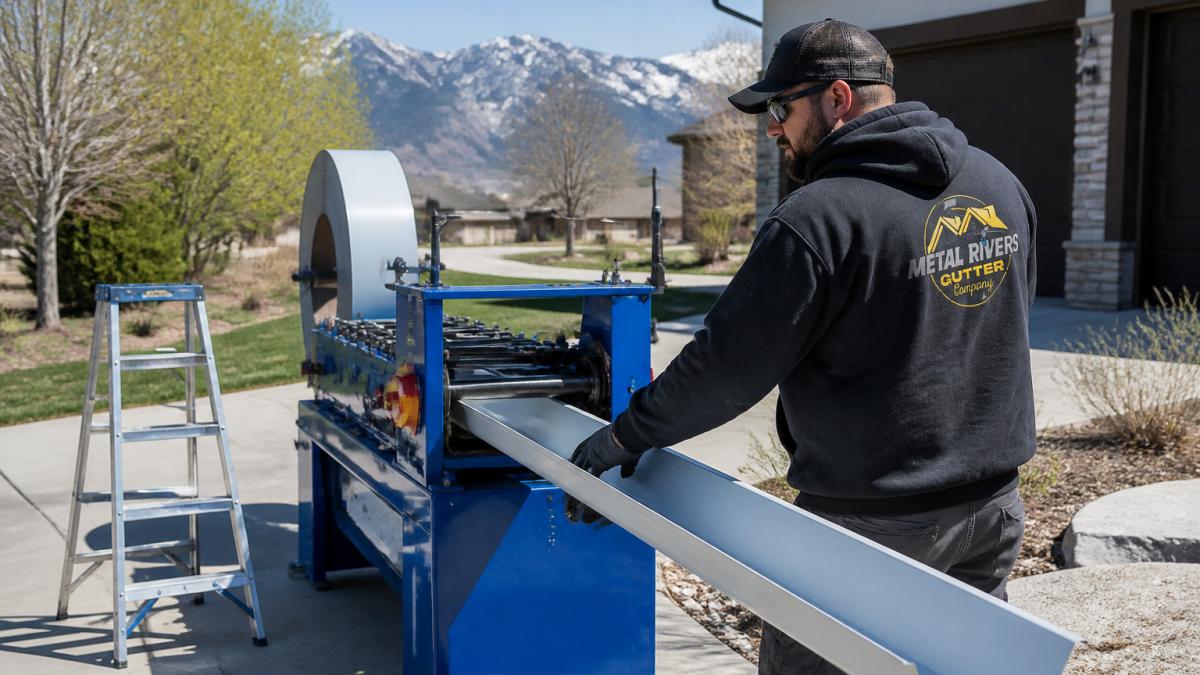
Here is how a proper on-site job runs, step by step, with the tools and safety checks that separate a clean install from a callback.
- Set up the machine on level ground near the house, with at least 20 feet of clear feed space behind it and room to walk the finished run forward. Chock the wheels, drop the stabilizer legs, and check the spindle lock before you load a coil.
- Load the coil and thread the lead edge through the rollers by hand until it grabs. Keep your fingers clear of the pinch points, and wear leather gloves when handling the coil edge because slit metal will cut you before you feel it.
- Roll and cut the first run to your measured length. Use a fine-tooth carbide blade or the machine’s built-in shear for a clean edge, and mark the cut line with a grease pencil so you do not lose your measurement.
- Test-fit the section against the fascia before it goes up. Check the reveal at both ends and confirm the miter angle at each corner. If the run rocks or gaps, stop and re-measure rather than forcing it.
- Hang the hangers on the correct spacing. Most practitioners set hidden hangers every 24 inches on center and within 12 inches of every seam, outlet, and end cap. Snap a chalk line first so the run stays straight.
- Seat and fasten the gutter with a slight slope toward the downspouts. A common target is 1/16 inch of fall per foot of run, which is enough to move water without making the gutter look crooked from the ground.
- Install downspouts, elbows, and end caps, then seal the joints with a gutter sealant rated for the material. Do not over-apply; a thin bead that squeezes out is stronger than a thick glob that traps water.
- Run water through it to check the flow and catch any leaks. Use a hose at the high end and watch the downspout outlet. If water pools more than a quarter inch anywhere, the slope is off.
Winter Ice Hazards Your New Gutters Help Eliminate
Winter is where a good gutter earns its keep. When meltwater refreezes, it does not just sit there, it builds.
Here is what a working gutter system helps you avoid:
- Ice dams that back water up under the shingles and into the attic.
- Icicles that form heavy and drop without warning.
- Frozen downspouts that trap water and split at the seams.
- Ice at the foundation that heaves and cracks as it thaws.
A seamless run with proper slope moves meltwater off the roof and away from the house before it can refreeze in the wrong spot. You can also learn how to reduce ice dam risks around gutters before the first hard freeze.
Get a Free Inspection and Quote from Metal Rivers
A gutter that fits right protects your home for decades. A gutter that was pieced together on a truck bed starts leaking the first hard freeze.
Metal Rivers Gutter Company has helped more than 300 homeowners across Fort Collins and Northern Colorado, with a 4.8-star rating on Google and a BBB A+ rating. We cut every run on site, back our work with a 5-year workmanship warranty, and stand behind manufacturer paint warranties that run from 20 years up to lifetime. We also offer a free gutter inspection, so you know exactly what your roofline needs before you spend a dime. And if your existing system is already showing its age, we handle gutter and downspout repair as well.
Get started with Metal Rivers Gutter Company and get a gutter system cut to fit your home, not the back of a truck.
Frequently Asked Questions
How do they make gutters on site?
A roll-forming machine sits on the truck or driveway, and flat aluminum coil feeds through it to form the gutter profile. The contractor measures each run, cuts the formed gutter to length, then adds end caps, miters, and downspout outlets. Because the run is one continuous piece, there are fewer joints where leaks start. Metal Rivers Gutter Company uses this process for custom gutter cutting on site in aluminum, copper, and galvanized steel.
Can gutters be cut to a custom length?
Yes. Custom gutter cutting on site means each run is measured against your actual roofline and cut to fit, not ordered in fixed 10-foot sticks. That matters on older homes where the fascia is not perfectly straight. Ask your installer to confirm lengths before the machine starts running.
Which gutter materials can be cut on site?
Aluminum is the most common because it is light and easy to form. Copper and galvanized steel can also be cut on site with the right machine setup. For custom gutter cutting on site aluminum is usually the most forgiving choice for homeowners. Confirm the material and profile with your contractor before the job.
How can gutters help reduce winter ice hazards around a home?
Gutters move meltwater off the roof and away from the foundation before it can refreeze. When gutters are clogged or missing, water spills over the edge and forms ice on walkways, steps, and driveways. Seamless runs with fewer joints also reduce the drips that create slick patches. Pairing gutters with a gutter guard keeps debris out so meltwater can drain in a thaw. That is the practical case for custom gutter cutting on site in cold climates.
Ready to stop patching and start protecting? Reach out for your free inspection and quote today.
