



Last Updated: November 1, 2026
Quick Summary
Seamless gutters commonly last 20 to 30 years when made of aluminum, and copper systems often outlast the roof they sit under. That range assumes proper installation and routine cleaning, since skipped maintenance can cut lifespan to 10 or 15 years in heavy-debris or ice-prone areas.
- Most residential seamless aluminum is 0.027 or 0.032 inch thick, and the thicker gauge resists denting better.
- Clear your gutters twice a year, and more often if you live under trees.
- One isolated leak is usually a repair, but three or more on the same run points to replacement.
- Never chip ice out of a gutter with a hammer or shovel, which dents metal and cracks vinyl.
- Flush the downspouts every time you clean the gutters, since a clear trough feeding a clogged downspout still overflows.
Table of Contents
- How Long Do Seamless Gutters Last?
- How Long Do Aluminum Gutters Last Compared With Other Materials
- Factors That Decide the Service Life of Seamless Gutters
- Signs Gutters Need Replacing (and Repair vs. Replace)
- How to Maintain Seamless Gutters So They Last
- Winter Ice Damage to Gutters and How to Prevent It
- Book a Free On-Site Gutter Inspection
- Frequently Asked Questions
How Long Do Seamless Gutters Last?
Seamless gutters can last decades when made of aluminum or copper, and copper often lasts longer. That is the short answer.
At Metal Rivers Gutter Company, we cut gutters on-site from one continuous piece of metal. No seams means fewer leak points, which is one reason seamless gutters often outlast sectional systems.
Here is what most guides get wrong: they quote a lifespan number and stop there. A gutter’s real service life comes down to four things.
- Material type
- Installation quality
- Weather exposure
- Maintenance frequency
Get those right and a gutter system can run well past two decades. Get them wrong and you will be replacing sagging, leaking runs in half that time.
Below, we break down expected lifespan by material, the warning signs that mean replacement, and the maintenance schedule that actually extends gutter life.
How Long Do Aluminum Gutters Last Compared With Other Materials
Aluminum gutters commonly last 20 to 30 years, according to Englert’s gutter material guide. For a deeper look at how aluminum and copper compare on durability and lifespan, see our aluminum vs copper gutter durability comparison. That range assumes proper installation and routine cleaning. Skip the maintenance and the number drops fast, sometimes to 10 or 15 years in heavy-debris or ice-prone areas.
Aluminum is the most common choice for good reason. It is light, it resists rust, and it costs less than copper. The trade-off is that thin aluminum can dent under heavy hail or a leaning ladder. Gauge matters here: most residential seamless aluminum is 0.027 or 0.032 inch thick.
Copper and Galvanized Steel: The Long End of the Range
Copper is known for a long service life, and many copper systems can outlast the roof they sit under. Copper develops a patina over time, and that oxidized layer actually protects the metal underneath. The catch is cost and softness, copper dents more easily than steel, and it is usually reserved for high-end or historic homes where the look justifies the expense.
Galvanized steel lands somewhere in the middle. Galvanized steel’s service life depends on coating quality and how much moisture the steel sees. A heavy zinc coating on a properly pitched, well-maintained run tends to last longer, while thin coating, poor drainage, or constant leaf debris shortens it. Once the zinc coating is breached, rust starts and spreads fast, especially in freeze-thaw climates where water sits in the trough and refreezes.
Vinyl and Sectional Gutters: The Short End
Vinyl gutters generally have a shorter service life than metal options. Sun exposure makes vinyl brittle, and brittle vinyl cracks in a hard freeze. In southern summers with intense UV, vinyl can chalk and fade within a few years, and the first ice storm after a cold snap often finishes the job.
Sectional gutters carry the same material lifespans but add a structural weakness: every seam is a future leak. Seamless gutters remove that failure point entirely. The metal is the same in both systems, but seamless runs avoid the seams where sectional gutters tend to leak.
When comparing quotes, ask about aluminum gauge and coating. A 0.032-inch gauge with a quality paint finish will outlast a thinner, bargain-grade panel every time, even if both are labeled “aluminum.”
Here is how the main gutter materials stack up on lifespan and trade-offs.
| Material | Typical lifespan | Key note |
|---|---|---|
| Aluminum | 20 to 30 years | Light, resists rust, costs less than copper |
| Copper | Outlasts the roof it sits under | Patina protects the metal; dents easily |
| Galvanized steel | Middle of the range | Depends on coating quality and moisture |
| Vinyl | Shorter than metal options | Sun makes it brittle; cracks in hard freeze |
| Sectional gutters | Same material lifespans | Every seam is a future leak |
Factors That Decide the Service Life of Seamless Gutters
Installation quality tops the list. A gutter hung with too few hangers will sag under the weight of standing water. Sagging creates low spots, and low spots hold water year-round.
Proper support matters just as much. Hangers and brackets should be spaced so the gutter holds its shape through snow load and heavy rain.
Weather exposure is the wild card. A home under pine trees collects debris fast. A home on an open, wind-whipped lot takes more stress on fasteners. Both shorten service life.
Then there is maintenance frequency. Clean gutters shed water. Clogged gutters hold it, and standing water is what drives corrosion, rust, and rot.
Watch out: the most common mistake we see is homeowners judging gutter health from the ground.
Signs Gutters Need Replacing (and Repair vs. Replace)
The clearest signs gutters need replacing are leaks at multiple points, visible sagging, rust or corrosion holes, and gutters pulling away from the fascia. One isolated leak is usually a repair. Three or more on the same run points to replacement.
Here is a simple way to decide:
- One leak, solid metal: repair it.
- Sagging in one spot: re-hang that section.
- Rust holes or cracks in multiple spots: replace the run.
- Gutter separating from the roofline: inspect the fascia before you do anything else.
Age matters too. If you are still on the fence, our gutter repair vs replacement guide walks through the full decision. A 25-year-old aluminum system with recurring leaks has already given you its service life. Patching it again just delays the inevitable.
How to Maintain Seamless Gutters So They Last
Routine cleaning is the single highest-return maintenance task. Clear the gutters twice a year, and more often if you live under trees. Late fall, after the leaves drop, is the most important cleaning of the year.
Follow this schedule to extend gutter life:
- Spring: clear winter debris and check for loose hangers.
- Late fall: clear leaves and needles before the first freeze.
- After major storms: check for dents, loose brackets, and downspout clogs.
- Annually: flush the downspouts and confirm water drains away from the foundation.
Gutter guards cut the frequency of cleaning. A quality guard keeps leaves and needles out of the trough while still letting water through. It does not make a gutter maintenance-free, but it makes the job far less frequent.
What most guides miss is the downspout. A clear trough feeding a clogged downspout still overflows. Flush the downspouts every time you clean the gutters.
When you would rather hand the job to a crew, our gutter cleaning service keeps the system flowing.
Winter Ice Damage to Gutters and How to Prevent It
Winter is where gutters earn their keep, and where they take the worst damage. The core problem is freeze-thaw cycling: snow melts off a warm roof, hits the cold gutter, and refreezes.
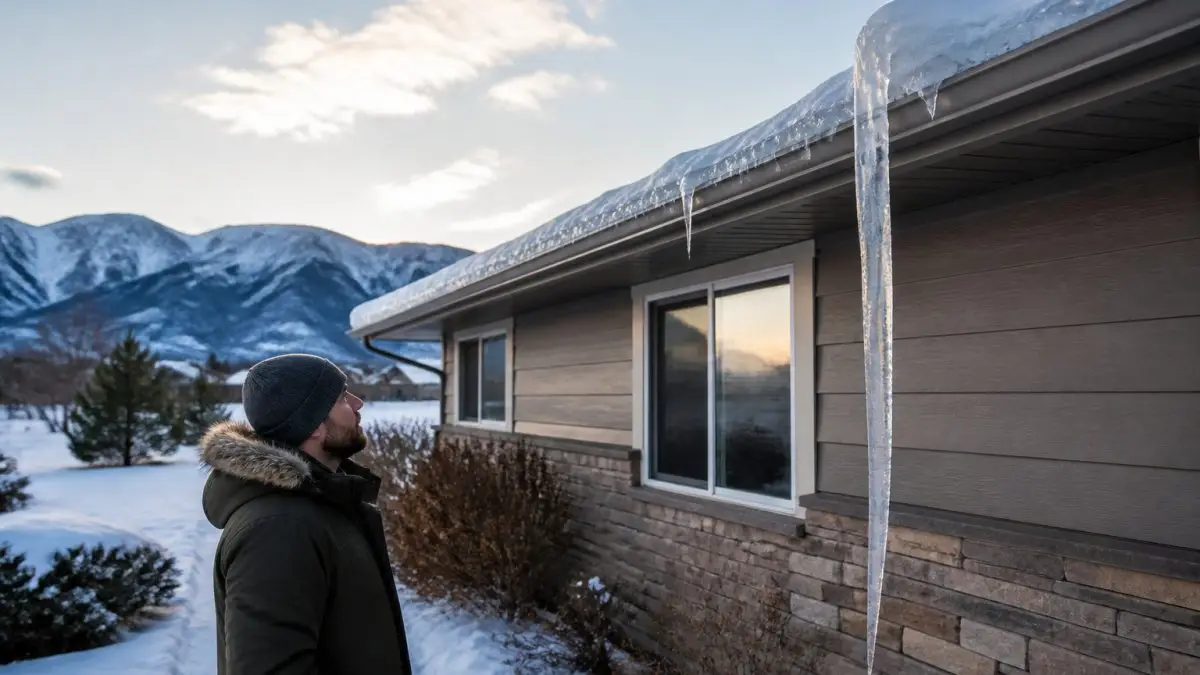
Here are the winter ice hazards a working gutter system helps eliminate, and what happens when gutters fail:
- Ice dams at the roof edge. A clogged gutter is the most common cause of ice dams. Water backs up, freezes under the shingles, and melts into the attic or down the interior walls. Clear, properly pitched gutters carry that meltwater away before it can dam up.
- Icicle weight. Long icicles are not just a look, they are heavy. A thick icicle hanging off a clogged gutter can weigh enough to pull the hanger loose or crack the trough. Seamless runs with proper hanger spacing handle that load far better than sagging sectional systems.
- Gutter separation and sagging. When ice fills a clogged trough, the expansion pushes the front edge out and pulls the back edge away from the fascia. Once that happens, the gutter is no longer catching water, it is just hanging there.
- Fascia and soffit rot. Water that backs up behind the gutter and refreezes works its way into the wood. Repeated freeze-thaw cycles turn that wood soft, and soft fascia cannot hold hangers. That is how a small ice problem becomes a full replacement.
- Downspout ice plugs. A clear trough feeding a frozen downspout still overflows. Water pours over the front edge, freezes on the walkway, and creates a slip hazard. Flushing downspouts before the first hard freeze is the simplest prevention.
A Northern Colorado cold snap is a good example: snow melts off the warm roof, hits the cold gutter, and refreezes. A clogged trough turns that into an ice dam along the roofline. Long icicles can hang off the edge. The weight pulls hangers loose.
Clear gutters before the first hard freeze. If ice dams are already a worry, our ice dam prevention service prepares your gutters and roofline drainage for winter. That one step prevents most of it. A properly pitched system also drains before water has a chance to sit and freeze.
Never chip ice out of a gutter with a hammer or shovel. You will dent the metal, crack vinyl, and possibly tear the gutter off the fascia. Use a roof rake to clear snow from the roof edge, and call a pro if ice has already dammed up.
Book a Free On-Site Gutter Inspection
A gutter system’s real lifespan is decided long before the first leak shows up. Material, hanger spacing, pitch, and maintenance all set the clock. A free on-site inspection tells you where your system stands right now.
Metal Rivers Gutter Company cuts custom seamless gutters on-site for a precise, leak-free fit. We back the work with a 5-year workmanship warranty and manufacturer paint warranties ranging from 20 years up to lifetime. Our business holds a BBB A+ rating and a 4.8-star Google rating from 51 reviews.
Get started with Metal Rivers Gutter Company and book a free on-site gutter inspection to see exactly how much life your gutters have left.
Frequently Asked Questions
Do seamless gutters last longer than sectional gutters?
Seamless gutters generally outlast sectional gutters because they have no joints for water to find. Sectional runs are pieced together every few feet, and each seam is a spot where sealant dries out, pulls apart and starts leaking. Seamless gutters are cut to the length of the run on site, so a typical wall gets one continuous piece of aluminum or copper from end to end. Fewer joints means fewer failures, which is why a well-installed seamless system often reaches 20 to 30 years while sectional runs can need patching sooner.
How do you know when it is time to replace rather than repair?
Look at how many problems you have and where they sit. A single loose hanger or one leaking corner is usually a repair. Signs gutters need replacing include seams that keep opening after being resealed, long runs of sagging between brackets, pinholes or rust spreading across multiple sections, and fasteners that pull loose because the fascia behind them is soft. If the gutters are past 20 years old and you are calling for repairs two or three times a season, replacement usually costs less than patching a failing system.
Will gutters actually make ice dams worse in the winter?
A clogged gutter makes ice dams worse, but a working one helps. Ice dams form when snowmelt refreezes at the cold roof edge. If the gutter is packed with leaves and frozen solid, meltwater has nowhere to go and backs up under the shingles. A clean, properly pitched seamless gutter moves that water away to the downspout. Winter ice damage to gutters is mostly a drainage problem, so routine cleaning in late fall does more to prevent it than anything else. Gutter guards cut how often debris builds up in the first place.
What affects how long seamless gutters last most?
Installation quality and maintenance beat material choice in most cases. A copper gutter hung with too few hangers and pitched wrong will fail before a well-installed aluminum one. After that, it comes down to material and exposure: aluminum, galvanized steel and copper each have different typical lifespans, with copper generally lasting longest. Heavy tree cover, freeze-thaw cycles and how often the gutters get cleaned all move the number up or down.

