



Last Updated: November 14, 2026
Quick Summary
Aluminum gutters in Colorado work well because the metal expands and contracts with temperature swings, resists rust, and stays light enough to hold its pitch through a Front Range winter. Most Colorado homes do fine with 5-inch K-style aluminum, though large roof planes or a history of overflow call for 6-inch. Seamless aluminum runs, fabricated on site, cut down on the joints where leaks start.
- Aluminum resists rust and handles temperature swings, while steel is heavier and more dent-resistant for hail-prone roofs.
- Step up to 6-inch gutters when roof area is large, the pitch is steep, or runs are long.
- Upsizing the gutter without adding downspouts is a common mistake that still leaves you with overflow.
- A fine micro-mesh guard is the only style that reliably sheds pine needles.
- No guard makes a gutter maintenance-free, and guards don’t replace attic insulation and ventilation for ice dams.
Table of Contents
- Why Aluminum Gutters Fit Colorado Weather
- Aluminum vs. Steel Gutters: Which Metal Holds Up
- Sizing Your System: 5-Inch vs. 6-Inch Gutters
- What Seamless Aluminum Gutters Change About Leaks
- Aluminum Gutter Installation: On-Site vs. Sectional
- Do Aluminum Gutter Guards Stop Pine Needles and Ice?
- What Drives the Cost of an Aluminum Gutter Project
- Book a Free On-Site Gutter Inspection
- Frequently Asked Questions
Why Aluminum Gutters Fit Colorado Weather
Aluminum gutters in Colorado make sense for one blunt reason: the metal moves with the weather instead of fighting it. Aluminum expands and contracts with temperature swings, resists rust, and stays light enough that a properly hung system holds its pitch through a Front Range winter.
The stakes are higher than most folks realize. According to WestPro Roofing’s Colorado gutter cost guide, the average Colorado home spends about $3,980 on gutter replacement, roughly $12.04 per linear foot installed.
Temperature Swings, Hail, and Freeze-Thaw
A sunny January afternoon here can hit 50 degrees, then drop below zero that same night. Water in a sagging trough freezes, expands, and pushes seams apart. Hail dents thin metal and knocks loose hangers.
Watch out: the real damage usually isn’t the gutter itself. It’s the ice that backs up under the shingles and creeps into the attic decking.
Winter Ice Hazards Your Gutters Help Eliminate
A working aluminum gutter system doesn’t just move summer rain; it’s your first line of defense against a handful of winter problems that show up on almost every block in this part of the country. Here are the ones we see most often and how a properly sized, properly pitched aluminum system short-circuits them:
- Ice dams at the roof edge. When snow melts up-slope and refreezes at the cold eaves, water backs up under shingles and into the attic. A clean, free-flowing gutter carries meltwater away before it can pool and refreeze. Aluminum’s smooth interior and rust-free surface keep the trough clear season after season.
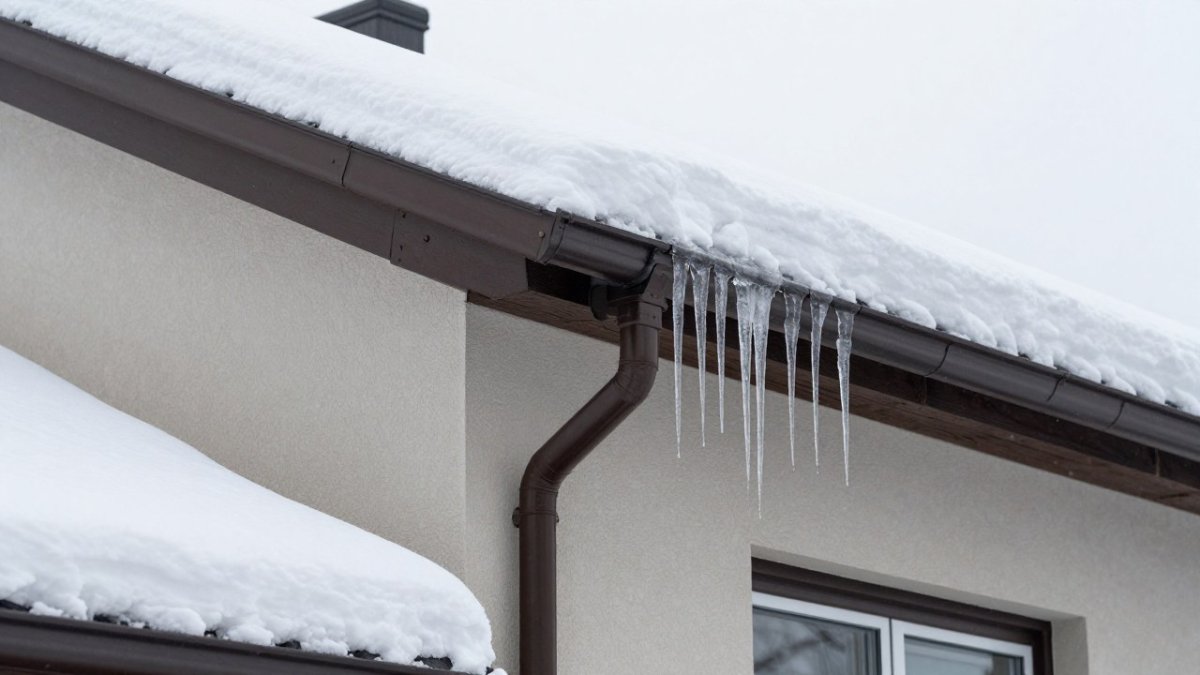
- Icicles the size of fence posts. Those dramatic icicles hanging off the roofline are a sign of water refreezing at the edge. A gutter that drains fast and a downspout that stays open give meltwater somewhere to go instead of dangling over the walkway.
- Frozen and split downspouts. Water trapped in a downspout expands when it freezes and can split the seam or push the elbow apart. Aluminum’s resistance to corrosion means the metal won’t already be thin and weak when that freeze hits, and proper downspout placement with adequate outlets reduces the chance of standing water inside the pipe.
- Ice sheets on walkways and driveways. When gutters overflow or downspouts dump right at the foundation, that water freezes into a sheet that’s a lawsuit waiting to happen. Extending downspouts and keeping the trough clear sends meltwater away from traffic areas.
None of this replaces proper attic insulation and ventilation, which are what actually stop ice dams from forming in the first place. Keeping that system clear is where gutter cleaning earns its keep, and if a hard freeze has already pulled a hanger loose or split a seam, gutter and downspout repair gets the run back in shape before the next storm rolls through.
Aluminum vs. Steel Gutters: Which Metal Holds Up
Aluminum wins for most homes, steel wins for the hardest exposures. Aluminum resists rust by nature, handles temperature swings without warping, and costs less installed.
Aluminum suits most homes because it resists rust and handles temperature swings, while steel may be the better call where heavier-duty performance is needed.
For a deeper look at how aluminum stacks up against a longer-life metal, see our comparison of aluminum and copper gutter durability.
| Material | Rust Resistance | Weight | Hail/Dent Resistance | Best For |
|---|---|---|---|---|
| Aluminum | Excellent | Light | Moderate | Most homes, budget-minded projects |
| Steel | Good with coating | Heavy | High | Hail-prone, heavy-duty use |
| Copper | Excellent | Medium | Moderate | Long lifespan, curb appeal |
Sizing Your System: 5-Inch vs. 6-Inch Gutters
Six-inch gutters carry more water than five-inch, and that margin matters on big roofs and steep pitches. Choosing gutter capacity alongside the right siding helps Colorado homes manage weather as a whole, and Sunset Restoration connects those exterior decisions.
The math is simple: a bigger trough handles a faster downpour before water sheets over the front edge. If you’re weighing a custom-fit seamless system against pieced-together sections, our guide on choosing between seamless and sectional gutters walks through the trade-offs.
A Practical Sizing Method You Can Run Yourself
Most folks don’t need a calculator to pick a gutter size, but they do need a repeatable way to think about it. Here’s the method we use on site, boiled down so you can sanity-check any quote you get.
- Figure the roof area draining to each run. Measure the footprint of the roof section that feeds a given gutter run (length times the horizontal distance from the ridge to the gutter). A simple gable roof might feed 600 square feet to one side; a complex roofline with valleys can concentrate two or three times that onto a single run.
- Adjust for roof pitch. A steep roof sheds water faster and presents more surface to the rain, so the effective load is higher than the footprint suggests. Steeper roofs push more water into the gutter, so the effective load can be higher than the footprint suggests. Flat or low-slope roofs drain slower, which can also cause overflow at the gutter.
- Check your local rainfall intensity. Heavy summer storms can drop water faster than a small gutter can carry it. If your run is long or your roof area is large, the numbers push you toward 6-inch.
- Count and place downspouts. This is the step most homeowners skip. A 5-inch gutter with one downspout at the end of a 40-foot run will overflow in a hard rain even though the trough itself is big enough. The fix is often more downspouts, not bigger gutters. Outlets placed at low points and near valleys help move water quickly off the roof.
- Look at the history. If you’ve got stains under the gutter line, soil erosion at the foundation, or water sheeting over the front edge during storms, the existing system is undersized or under-downspouted. That’s your cue to step up to 6-inch or add outlets.
When to Step Up to 6-Inch
Six-inch aluminum is worth considering when any of these describe your home:
- Roof area feeding a single run is large (think a big ranch or a two-story with wide planes).
- The roof pitch is steep enough that water arrives fast.
- The run is long, with few natural downspout locations.
- You’ve already had overflow problems with 5-inch.
- You’re in an area that sees intense summer thunderstorms.
For most standard homes, 5-inch K-style aluminum with correctly spaced downspouts is plenty. The upgrade to 6-inch is about capacity and peace of mind, not appearance; both sizes are available in the same colors and profiles.
Watch out: upsizing the gutter without adding downspouts is a common mistake. A 6-inch trough with one undersized outlet can still overflow, and you’ve paid for capacity you can’t use.
What Seamless Aluminum Gutters Change About Leaks
Seamless aluminum gutters are custom-fabricated in one continuous run on site, so the only joints sit at corners and downspout outlets. Fewer joints means fewer places for water to find a way out.
A seamless aluminum system is built for each individual building, so the gutter fits the roofline instead of the roofline settling for whatever length was on the shelf.
Aluminum Gutter Installation: On-Site vs. Sectional
On-site fabrication beats sectional installation on fit and longevity, but it demands a contractor who measures carefully and pitches the run correctly. A seamless run is best left to a contractor who measures carefully and pitches the run correctly.
Here’s how we’d decide:
- Choose seamless if your home has long runs, complex rooflines, or you’re tired of chasing leaks.
- Choose sectional only for a shed, garage, or short run where appearance doesn’t matter much.
- Hire out either way if the work sits above one story or near power lines.
Watch out: ladder work on a two-story home is where most DIY gutter projects turn into emergency room visits. A fall from gutter height is not a minor tumble.
Do Aluminum Gutter Guards Stop Pine Needles and Ice?
Gutter guards cut cleaning frequency, but no guard makes a gutter maintenance-free. Pine needles are the toughest debris out there: they slip through wide openings, mat down, and hold water against the metal.
On ice, guards help indirectly. For a full breakdown of guard styles built for needle clogs, read our guide to the best gutter guards for pine needles.
What Drives the Cost of an Aluminum Gutter Project
Cost comes down to four things: linear footage, gutter size, stories, and how much old material has to come down. A Colorado installation guide from WGCC reports a range of $1,800 to $6,500 for new seamless gutters, with most homes running 150 to 250 feet of 5- or 6-inch aluminum paying $2,200 to $4,000.
We don’t quote prices over the phone, because a number given blind is a number we’d have to walk back. Instead, we measure the roofline, check the fascia, and count downspout locations. For a closer look at what moves the number up or down, see our gutter installation cost guide for Fort Collins homeowners.
Book a Free On-Site Gutter Inspection
An inspection tells you what your gutters actually need, and it costs you nothing. We walk the roofline, check pitch and hanger spacing, look for rust and separation, and photograph anything that concerns us.
Metal Rivers Gutter Company is locally owned and carries a BBB A+ rating, a 5-year workmanship warranty, and manufacturer paint warranties running from 20 years up to lifetime. More than 300 customers and 312 completed projects back that up. Reach out to schedule your inspection and we’ll get you on the calendar.
Colorado weather will test any gutter system you put up. The right aluminum setup, cut to fit your roofline and hung by someone who knows freeze-thaw, handles it for decades.
Frequently Asked Questions
Are aluminum gutters a good choice for homes in Northern Colorado?
Yes, for most homes. Aluminum resists rust, handles the temperature swings between warm afternoons and freezing nights, and stays lightweight enough that it does not stress your fascia boards. Steel makes sense where you need heavier-duty performance, but for the average Fort Collins house, aluminum is the practical pick.
What is the difference between seamless and sectional aluminum gutters?
Sectional gutters come in pre-cut lengths joined with connectors, and every joint is a spot where water can find a way out. Seamless aluminum gutters are cut to length on site for your specific roofline, so a run from corner to corner has no seams to leak. That matters in Colorado, where freeze-thaw cycles work at every joint all winter long.
Can aluminum gutters help reduce ice dams and icicles?
They help by moving meltwater off the roof and away from the foundation instead of letting it pool and refreeze at the edge. Gutters do not fix an attic insulation problem, which is the root cause of most ice dams. But a properly sized system with good downspout drainage keeps the water that does melt from backing up under shingles or forming a skating rink by your back door.
How often should aluminum gutters be cleaned and inspected?
Twice a year is the baseline, once in late spring and once after the leaves drop. Homes with pine trees need more attention because needles slip through and pack down. Check for sagging, loose hangers, and downspouts that dump water right at the foundation. A free on-site inspection catches small problems before they turn into fascia rot or a wet basement.

